ERA OF INNOVATION · POLITICS
Women's Social and Political Union
1903 — 1915
The WSPU's actions were pivotal in advancing women's rights and suffrage in the UK.
1903 — 1915
The WSPU's actions were pivotal in advancing women's rights and suffrage in the UK.

Wikimedia Commons
World context
Oct 10, 1903On October 10, 1903, in a modest room in Manchester, Emmeline Pankhurst stands resolute, flanked by a group of determined women. They gather to establish the Women’s Social and Political Union, igniting a fierce campaign for suffrage that will challenge the very fabric of British society. The air crackles with ambition as they draft their manifesto, a declaration of their unwavering demand for equality and justice.
World context
1905In January 1905, the air in the House of Commons crackles with anticipation as Liberal MP Bamford Slack stands to introduce a women's suffrage bill, his voice steady yet charged with the weight of countless hopes. Outside, members of the Women's Social and Political Union rally, their banners fluttering like the wings of a determined bird, but inside, the debate stretches on, voices rising and falling, ultimately drowning out the very cause they champion. The clock ticks, and the moment slips away, leaving the suffragists to ponder their next move in the relentless pursuit of equality.
World context
1906In January 1906, amidst the fervent rallies and passionate speeches of the Women’s Social and Political Union, journalist Charles E. Hands coins the term 'suffragette' in a newspaper article. The word, tinged with both derision and admiration, captures the spirit of the women fighting tirelessly for their right to vote, as they march through the streets of London, banners held high, voices ringing with determination.

Wikimedia Commons
World context
Jun 1908In 1908, Emmeline Pankhurst stands resolute on a makeshift platform in Hyde Park, her voice rising above the roar of 300,000 supporters gathered for the Women's Sunday rally. The air is electric with the vibrant hues of purple, white, and green—the official colors of the Women’s Social and Political Union—fluttering like banners of hope and defiance against the oppressive winds of patriarchy. As she calls for suffrage, the crowd pulses with determination, a sea of women united in their demand for equality.

Wikimedia Commons
World context
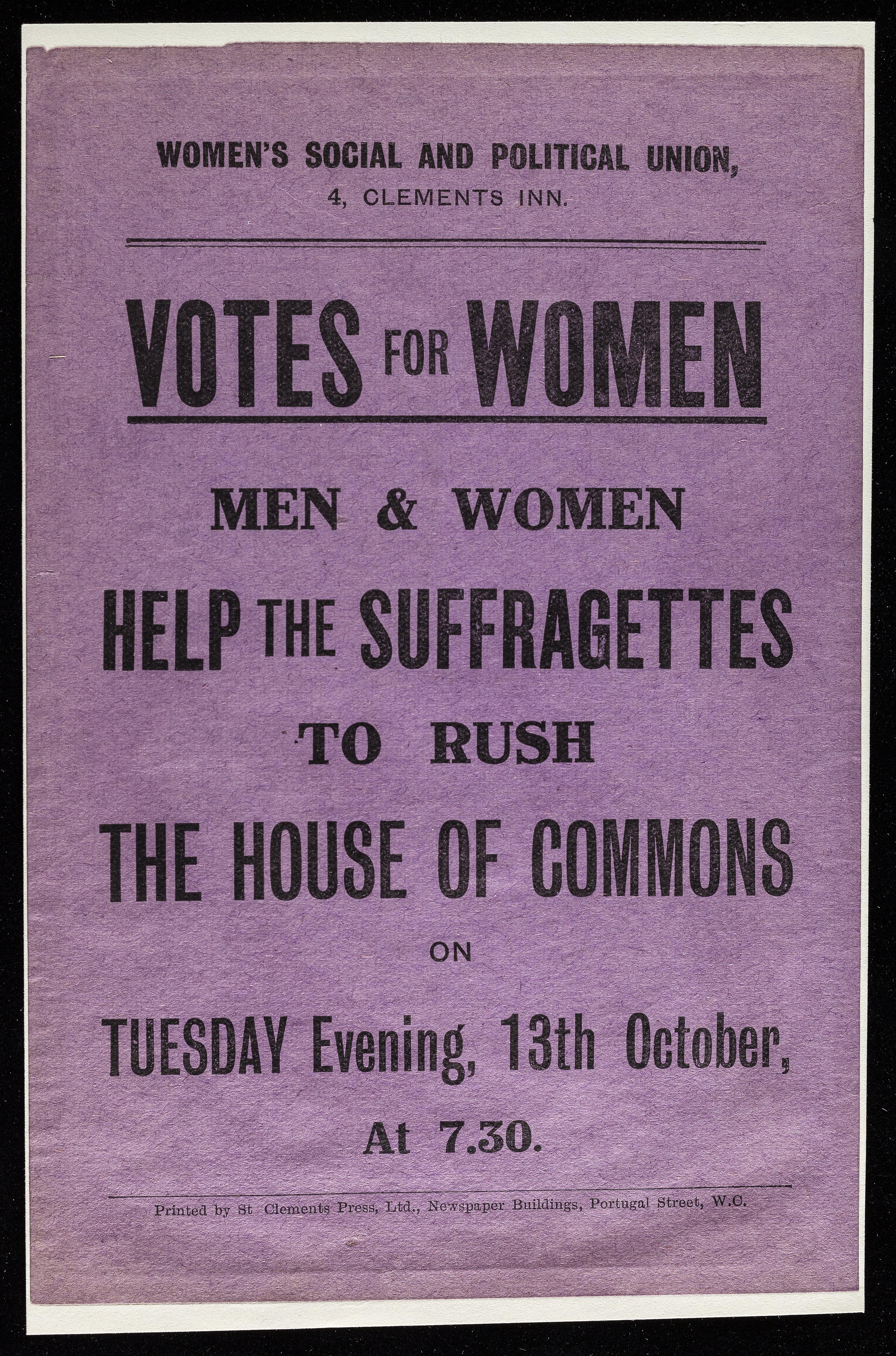
Oct 13, 1908On October 13, 1908, Emmeline Pankhurst stands resolute at the forefront of a throng of suffragettes, their voices rising in fervent unison as they surge toward the House of Commons. The air crackles with determination, but the police are ready, swiftly apprehending 37 women, their cries for justice echoing through the streets of London. Each arrest is a testament to their unyielding fight for the vote, a moment that ignites the suffrage movement with renewed vigor.

Wikimedia Commons
World context
Nov 18, 1910On November 18, 1910, Emmeline Pankhurst stands resolute at the forefront of a sea of determined women, their voices rising in unison as they march towards Parliament. The air crackles with defiance, banners held high, demanding the right to vote as they confront the stone façade of power. Each step echoes their frustration over the shelving of the Conciliation Bill, a pivotal moment in the struggle for women's suffrage.
World context
Nov 21, 1911On November 21, 1911, Emmeline Pankhurst leads a determined group of suffragettes down Whitehall, their hearts pounding with purpose. With a swift motion, they shatter the glass of government buildings, the sound echoing through the streets, as 160 women are swiftly arrested, their resolve unbroken in the fight for women's rights. The air crackles with defiance, a bold statement against a society that has long silenced them.
World context
Feb 19, 1913On February 19, 1913, the air crackles with tension as a bomb detonates in Pinfold Manor, the serene country home of Chancellor Lloyd George. Emmeline Pankhurst, a fierce leader of the Women's Social and Political Union, orchestrates this act of defiance, shaking the foundations of political complacency and igniting a fervor for women's suffrage across Britain. The explosion reverberates not just through the manor's walls, but through the very fabric of society, demanding attention to the cause of equality.
World context
Jun 1913In 1913, the air crackles with tension at the Epsom Derby as Emily Davison, a determined suffragette, darts onto the racetrack, her heart pounding with purpose. She lunges toward the King's horse, a suffragette banner clutched tightly in her hands, but the thundering hooves strike her down, a tragic testament to her unwavering fight for women's rights. The crowd gasps, the race forgotten, as her sacrifice echoes through the ages.
World context
Mar 9, 1914In the crisp air of March 9, 1914, Glasgow erupts into chaos as forty militant suffragettes clash with police, their voices rising in defiance against the arrest of Emmeline Pankhurst. The sound of fists meeting flesh and the shouts of women demanding their rights fill the streets, a fierce testament to their unwavering resolve. Amid the tumult, Pankhurst stands as a beacon of courage, her presence igniting the fervor of those around her.

Wikimedia Commons
World context
Aug 1914August 1, 1914. The sun casts a warm glow over the streets of London as Emmeline Pankhurst stands before a crowd of jubilant supporters, her voice rising above the cheers. The British government has just announced the release of all WSPU suffragettes from prison, a momentary truce in their relentless fight for women's rights, as the nation braces itself for the storm of war looming on the horizon.
World context
1915On January 1, 1915, Emmeline Pankhurst stands resolute at the front of a sea of 30,000 women in London, their banners fluttering in the winter breeze. They march with purpose, demanding the right to serve in the war effort, their voices rising in unison, echoing the urgency of their cause. The streets pulse with determination as they challenge the constraints of a society that has long sidelined them.
Keep exploring