IDEA · PHYSICS
General Theory of Relativity
1905 — 1929
It transformed the understanding of gravity and the structure of the universe.
1905 — 1929
It transformed the understanding of gravity and the structure of the universe.

Jules Henri Poincaré · Public domain
World context
1905In January 1905, Henri Poincaré sits at his desk, quill in hand, as he meticulously formulates a groundbreaking theory that intertwines the dynamics of the electron with the fabric of spacetime. His insights suggest that gravitational waves, like light, travel at an unyielding speed, challenging the very foundations of physics. The air is thick with the promise of a new understanding, as the world inches closer to the revolutionary ideas that will reshape the cosmos.
Wikimedia Commons
World context
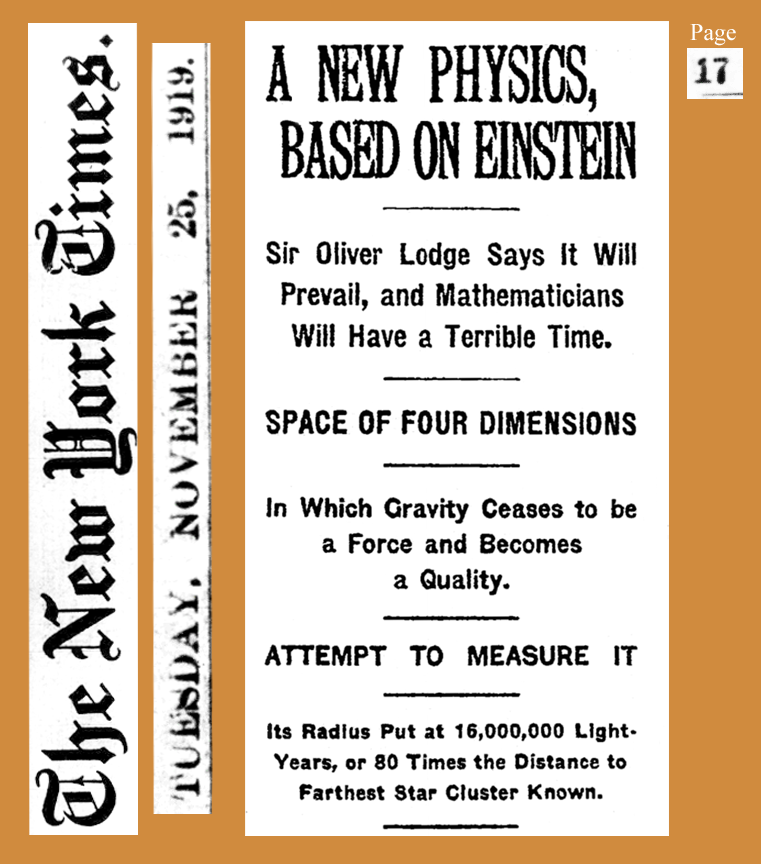
190519191125 A New Physics Based on Einstein - The New York Times

Wikimedia Commons
World context
1905Albert Einstein and Charlie Chaplin City Lights premiere 1931

Профессор Вильгельм Хайнрих · Public domain
In January 1907, Albert Einstein sits at his cluttered desk in Bern, Switzerland, his brow furrowed in concentration. He envisions an observer in free fall, weightless, as he grapples with the implications of gravity and acceleration, igniting an eight-year quest that will reshape the very fabric of physics. The air is thick with possibility as he scribbles equations, each stroke a step closer to a revolutionary understanding of the universe.
AI-reconstructed · Chronos
Loading…
Sign in to join the discussion.

Wikimedia Commons
On November 1, 1915, Albert Einstein stands before the Prussian Academy of Sciences in Berlin, his heart racing with anticipation. With chalk in hand, he scrawls complex equations on the blackboard, the symbols dancing like stars in the cosmos, as he unveils the Einstein field equations—an audacious framework that will forever alter humanity's understanding of gravity and the fabric of space-time. The room buzzes with a mix of skepticism and awe, the air thick with the promise of a new scientific era.
AI-reconstructed · Chronos
Loading…
Sign in to join the discussion.
World context
1916In the quiet of a new year, 1916, Karl Schwarzschild sits in a makeshift observatory, his mind racing with the implications of Einstein's revolutionary theories. With a pencil scratching against paper, he meticulously derives the first non-trivial exact solution to the Einstein field equations, unveiling the Schwarzschild metric that will forever alter the understanding of gravity and black holes. Outside, the world remains unaware of the cosmic secrets he is about to unlock.

Ferdinand Schmutzer · Public domain
In January 1917, Albert Einstein sits at his desk in Berlin, scribbling equations that will reshape humanity's understanding of the cosmos. He introduces the cosmological constant, a bold move to maintain a static universe, countering the prevailing notion of an expanding cosmos. The ink dries, and with it, a new chapter in physics begins to unfold.
AI-reconstructed · Chronos
Loading…
Sign in to join the discussion.

Frank Watson Dyson / Arthur Eddington / · Public domain
World context
May 29, 1919On May 29, 1919, under the shadow of the eclipsed Sun, Arthur Eddington stands on the remote island of Principe, peering through his telescope. As the stars shimmer around the darkened solar disk, he captures the first evidence of Einstein's general relativity, the starlight bending as predicted. Excitement ripples through the scientific community, marking a pivotal moment in the understanding of gravity and the cosmos.
World context
1922In January 1922, Alexander Friedmann sits at his cluttered desk in St. Petersburg, scribbling equations that dance across the page. As he delves into Einstein's general theory of relativity, he uncovers a groundbreaking revelation: a universe that expands, free from the constraints of a cosmological constant. The implications of his work ripple through the fabric of physics, hinting at a dynamic cosmos yet to be fully understood.

Wikimedia Commons
World context
1929In 1929, Edwin Hubble stands before the Mount Wilson Observatory's colossal telescope, peering into the depths of the cosmos. He meticulously analyzes the light from distant galaxies, revealing a startling truth: they are moving away from us, their light redshifted, signaling an expanding universe that shatters Einstein's notion of a static cosmos. The implications ripple through the scientific community, igniting debates that will reshape our understanding of space and time.
Keep exploring